Mastering JavaScript Closures: Analyzing a Counter Factory Pattern
Closures are a fundamental JavaScript concept that enable powerful programming patterns like data privacy, factory functions, and functional programming techniques. This article dissects a practical closure implementation to reveal how JavaScript manages scope, memory, and encapsulation.
Introduction: The Power of Closures
Closures are one of JavaScript's most powerful yet frequently misunderstood features. They allow functions to access variables from an outer scope even after that outer function has finished executing. This capability enables elegant patterns for data privacy, state management, and functional programming. Let's analyze a real-world closure implementation to understand how they work under the hood.
The Code: A Feature-Rich Counter Factory
Below is a practical example demonstrating closures through a counter factory that creates independent counter instances with private state and multiple methods:
function createCounter(initialValue = 0, step = 1) {
  // Private variables - only accessible within this closure
  let count = initialValue;
  let history = [];
  const createdAt = new Date();

  // Private helper function
  function logOperation(operation, previousValue, newValue) {
    history.push({
      operation,
      previousValue,
      newValue,
      timestamp: new Date()
    });

    // Keep history limited to last 50 operations
    if (history.length > 50) {
      history.shift();
    }
  }

  // Return public API - these functions form closures
  return {
    increment() {
      const oldValue = count;
      count += step;
      logOperation('increment', oldValue, count);
      return count;
    },

    decrement() {
      const oldValue = count;
      count -= step;
      logOperation('decrement', oldValue, count);
      return count;
    },

    reset() {
      const oldValue = count;
      count = initialValue;
      logOperation('reset', oldValue, count);
      return count;
    },

    getValue() {
      return count;
    },

    setValue(newValue) {
      if (typeof newValue !== 'number') {
        throw new TypeError('Value must be a number');
      }
      const oldValue = count;
      count = newValue;
      logOperation('setValue', oldValue, count);
      return count;
    },

    getHistory() {
      return history.map(entry => ({ ...entry }));
    },

    getAge() {
      return Date.now() - createdAt.getTime();
    },

    getInfo() {
      return {
        currentValue: count,
        initialValue,
        step,
        operationCount: history.length,
        age: this.getAge(),
        created: createdAt.toISOString()
      };
    }
  };
}

const counter1 = createCounter(0, 1);
const counter2 = createCounter(100, 5);

console.log(counter1.increment());
console.log(counter1.increment());
console.log(counter2.decrement());

console.log(counter1.getValue());
console.log(counter2.getValue());

console.log(counter1.getHistory());
console.log(counter1.getInfo());
Understanding Closure Formation
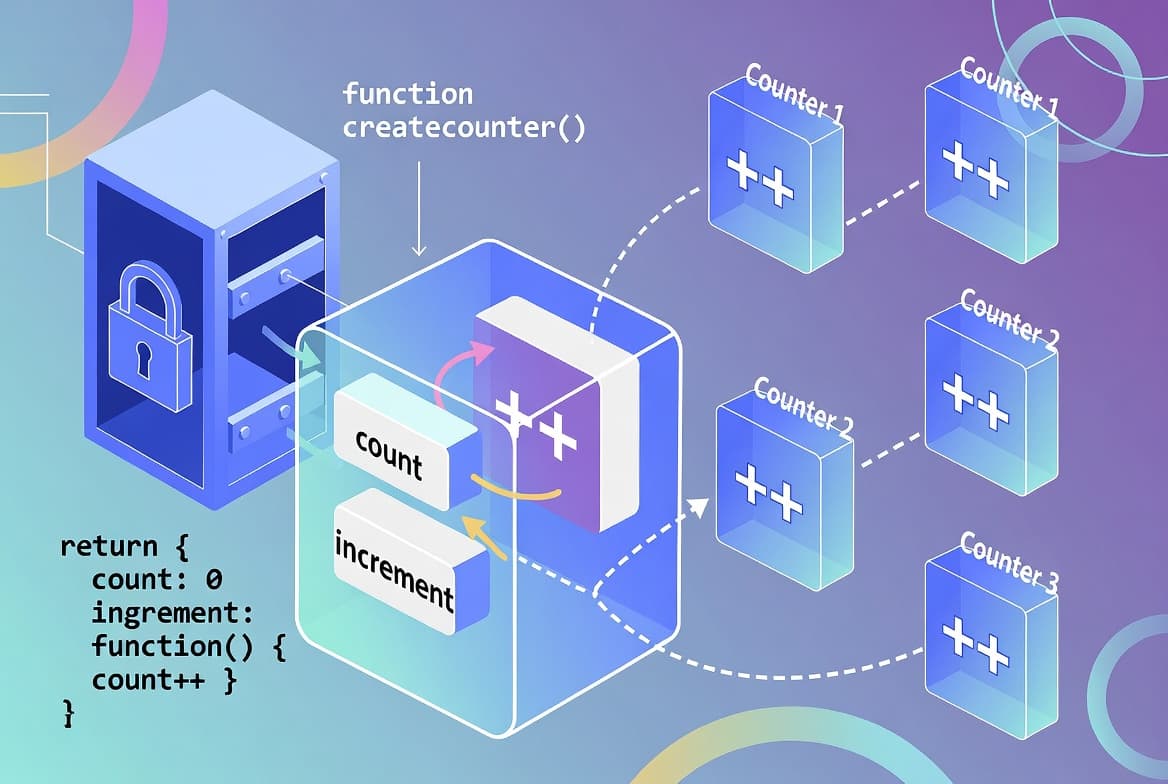
When createCounter executes, it creates a new execution context with local variables: count, history, and createdAt. Normally, these variables would be garbage-collected after the function returns. However, because the returned object's methods reference these variables, JavaScript maintains them in memory. Each method 'closes over' these variables, forming closures that preserve access to the outer scope.
Private State and Encapsulation
The variables count, history, and createdAt are truly private—there's no way to access them directly from outside the factory function. This is genuine data privacy, unlike properties prefixed with underscore conventions. External code can only interact with these variables through the public methods. This encapsulation prevents accidental modifications and enforces controlled access patterns, similar to private fields in class-based languages.
Independent Instances and Memory Management
Each call to createCounter creates completely independent closures. counter1 and counter2 each maintain their own separate count, history, and createdAt variables. Modifying one doesn't affect the other. This happens because each function call creates a new execution context with its own scope. The memory footprint includes the private variables and the function objects for each instance, which remain in memory as long as references to the counter objects exist.
The logOperation Helper Function
The private logOperation function demonstrates that closures can include helper functions that aren't exposed in the public API. It accesses the history array from the outer scope and maintains operation logs. The history size limit prevents unbounded memory growth—a crucial consideration in long-running applications. This pattern shows how closures enable internal implementation details that remain completely hidden from consumers.
Method Implementation Patterns
Each method in the returned object uses the closure to access and modify private state. The increment and decrement methods modify count using the step value. The setValue method includes input validation, demonstrating how closures can enforce business rules. The getHistory method returns a deep copy of the history array to prevent external code from modifying internal state—a defensive programming practice essential when returning reference types.
Closure vs. Class Comparison
This pattern could be implemented using ES6 classes with private fields (#privateField syntax). However, closures offer certain advantages: they're compatible with older JavaScript environments, they naturally prevent inheritance-related complications, and they make data privacy explicit through scope rather than syntax. Classes might be more familiar to developers from OOP backgrounds, but closures are more aligned with functional programming principles and can be more memory-efficient in some scenarios.
Common Pitfalls and Solutions
Closures can cause memory leaks if not managed carefully—keeping references to large objects in closures prevents garbage collection. The history size limit in this code addresses this concern. Another common mistake is creating closures in loops, where all iterations might share the same variable reference. Additionally, debugging closures can be challenging since private variables don't appear in console inspection. Using descriptive function names and proper error handling helps mitigate these issues.
Real-World Applications
Closures power many JavaScript patterns beyond counters. Module patterns use closures to create namespaces and manage dependencies. Event handlers rely on closures to maintain context. Currying and partial application in functional programming depend on closures. React hooks like useState and useEffect are implemented using closures to maintain state between renders. Understanding closures is essential for mastering advanced JavaScript patterns and modern frameworks.
Performance Considerations
Each closure instance carries a memory cost for maintaining its scope chain. Creating thousands of closure instances might impact performance in memory-constrained environments. However, modern JavaScript engines optimize closures heavily, and the benefits of encapsulation usually outweigh performance costs. Profile before optimizing—premature optimization often leads to less maintainable code. For most applications, the clarity and safety that closures provide make them an excellent choice.
Key Takeaways
- Closures allow functions to access variables from outer scopes even after those scopes have finished executing.
- They enable true data privacy and encapsulation without classes or special syntax.
- Each closure instance maintains independent state, making them ideal for factory functions.
- Private helper functions within closures can implement internal logic hidden from external code.
- Returning copies of reference types prevents unintended modifications to private state.
- Closures power many JavaScript patterns: modules, event handlers, currying, and React hooks.
- Memory management is important—limit data size in long-lived closures to prevent leaks.
- Modern JavaScript engines optimize closures efficiently, making them practical for most use cases.
- Understanding closures is fundamental to mastering JavaScript and functional programming patterns.