Top Frameworks in 2025: Web, Mobile, and Backend Development
Explore the ultimate guide to the leading frameworks in 2025. Compare their performance, use cases, advantages, and see practical code examples to help developers choose the right tools for modern applications.
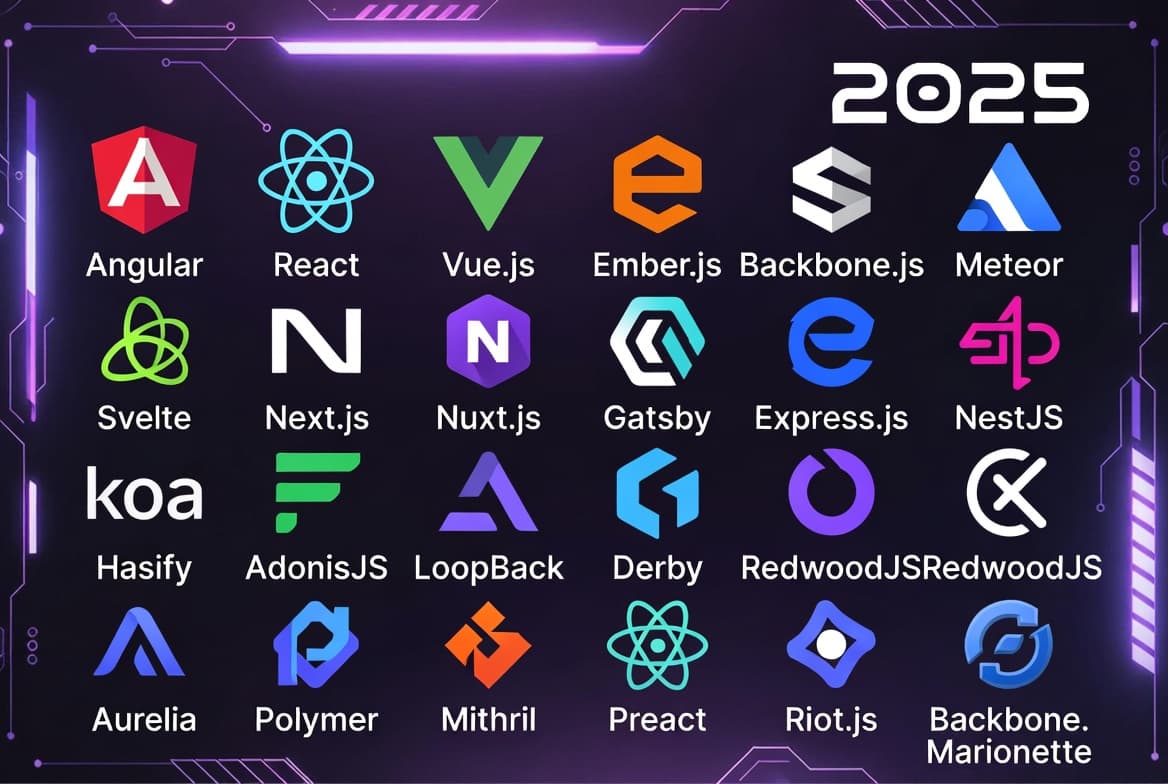
Introduction: Why Frameworks Matter in 2025
Frameworks remain the backbone of modern software development. They accelerate production by providing reusable components, standardized architecture, and built-in tools. In 2025, developers prioritize frameworks that combine speed, scalability, and excellent developer experience. Key trends include AI-powered development, edge computing, server-side rendering, and robust TypeScript support.
Choosing the right framework can reduce development time by up to 60%, improve code maintainability, and enhance collaboration across teams.
2025 Frontend Framework Trends
🔥 Key Trends in 2025:
- React Server Components (RSC)
- Edge-first architecture & distributed computing
- AI-powered dev tools & copilots
- Zero-config TypeScript
- Built-in performance optimization
- Native Web Components support
- Hot reload & instant feedback
Comparative Table: Frontend Frameworks 2025
| Framework | Use Cases | Advantages | Disadvantages | Performance | Market Share |
|-----------|-----------|------------|---------------|------------|--------------|
| React 19 | SPAs, SSR, Mobile | Huge ecosystem, concurrent rendering, hooks, RSC | Only view layer, extra state libraries needed | Virtual DOM, fiber, auto memoization | 40% |
| Next.js 15 | Full-stack apps, dashboards | App Router, SSR, API routes, SEO | Slight learning curve | Partial prerendering, Turbopack | - |
| Vue 3.4 | Small/medium apps, widgets | Easy to learn, Composition API, TS support | Smaller ecosystem | 20% faster than Vue 2, 13.5kb gzipped | 18% |
| Angular 18 | Large-scale SPAs, enterprise | Strong TypeScript, modular, RxJS | Steep learning curve, verbose | Signals-based reactivity, +30% faster | 20% |
| Svelte 5 | High-performance widgets & apps | No virtual DOM, minimal boilerplate, smallest bundles | Smaller ecosystem, fewer jobs | 30–50% smaller bundles than React | 5% |
| SolidJS 1.9 | Real-time dashboards, data-heavy apps | Fine-grained reactivity, no virtual DOM, JSX syntax | Smaller community | One of the fastest JS frameworks | Growing |
Visual Performance Comparison
In terms of initial load time and bundle size, frameworks like Svelte 5 and SolidJS 1.9 consistently outperform traditional frameworks, making them ideal for data-heavy or real-time applications. React 19 and Vue 3 remain versatile choices for large ecosystems and community support.
Frontend Frameworks in Action
### React 19 - Basic Example
```jsx
function App() {
  const [count, setCount] = useState(0);
  return (
    <div>
      <h1>Hello React 2025</h1>
      <button onClick={() => setCount(count + 1)}>Count: {count}</button>
    </div>
  );
}
```

### Vue 3 - Basic Example
```vue
<template>
  <div>
    <h1>{{ message }}</h1>
    <button @click="increment">Count: {{ count }}</button>
  </div>
</template>
<script setup>
import { ref } from 'vue';
const message = ref('Hello Vue 2025');
const count = ref(0);
const increment = () => count.value++;
</script>
```
Why These Frameworks Stand Out in 2025
- React 19 & Next.js 15: Best for ecosystem support, enterprise adoption, and modern SSR.
- Vue 3: Ideal for developers seeking simplicity with scalability.
- Angular 18: Preferred for enterprise-grade, large-scale apps with TypeScript rigor.
- Svelte 5: Minimalistic, blazing-fast for interactive or embedded apps.
- SolidJS 1.9: Ultra-performant for real-time dashboards and complex reactive UIs.
Backend & Mobile Frameworks (Preview)
In addition to frontend, frameworks like NestJS, Django, FastAPI, Spring Boot, Flutter, and React Native dominate 2025 for backend and mobile development, providing type-safe, scalable, and high-performance solutions for modern applications. Each of these frameworks brings unique advantages in terms of speed, maintainability, and developer experience.
Key Takeaways
- Frameworks are the backbone of modern development, improving speed, maintainability, and scalability.
- 2025 emphasizes AI tools, edge computing, SSR, and TypeScript.
- Choosing the right framework depends on project scale, performance needs, and team experience.
- Emerging frameworks like Svelte 5 and SolidJS offer unmatched performance for specific use cases.
- Established frameworks like React, Vue, and Angular continue to dominate due to community, ecosystem, and versatility.